Cine s-a întâlnit cu Edward the Black Prince?
Edith de Willesford datează Edward the Black Prince de la ? până la ?.
Edward the Black Prince
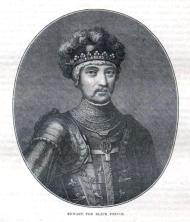
Edward of Woodstock (15 June 1330 – 8 June 1376), known as the Black Prince, was the eldest son and heir apparent of King Edward III of England. He died before his father, and so his son Richard II succeeded to the throne instead. Edward earned distinction as one of the most successful English commanders during the Hundred Years' War, being regarded by his English contemporaries as a model of chivalry, and one of the greatest knights of his age. Edward was made Duke of Cornwall, the first English dukedom, in 1337. He was made Prince of Wales in 1343, and knighted by his father at La Hougue in 1346.
In 1346, Prince Edward commanded the vanguard at the Battle of Crécy. He took part in Edward III's 1349 Calais expedition. In 1355, he was appointed the king's lieutenant in Gascony and ordered to lead an army into Aquitaine on a chevauchée, during which he sacked Avignonet, Castelnaudary, Carcassonne, and Narbonne. In 1356, on another chevauchée, he ravaged Auvergne, Limousin, and Berry, but failed to take Bourges. The forces of King John II of France met Edward's armies near the city of Poitiers. After negotiations between them broke down, at the Battle of Poitiers, the Edward's forces routed the French army and captured King John.
In 1360, he negotiated the Treaty of Brétigny. He was made Prince of Aquitaine and Gascony in 1362, but his suzerainty was not recognised by the lord of Albret or other Gascon nobles. He was directed by his father to stop the raids of the English and Gascon free companies in 1364. He made an agreement with Kings Peter of Castile and Charles II of Navarre, by which Peter covenanted to mortgage Castro Urdiales and the province of Biscay to him as security for a loan; in 1366, a passage was secured through Navarre. In 1367, he received a letter of defiance from Henry of Trastámara, Peter's half-brother and rival. After a conflict that same year, he defeated Henry at the Battle of Nájera. However, after a wait of several months—during which, he failed to obtain either the province of Biscay, or liquidation of the debt from Don Pedro—he returned to Aquitaine. Edward persuaded the estates of Aquitaine to allow him a hearth tax of ten sous for five years in 1368, thus alienating the lord of Albret and other nobles.
Prince Edward returned to England in 1371 and resigned the principality of Aquitaine and Gascony in 1372. He led the Commons in their attack upon the Lancastrian administration in 1376. He died in 1376 of dysentery and was buried in Canterbury Cathedral.
Citește mai mult...