Cine s-a întâlnit cu Ecaterina a II-a a Rusiei?
Alexander Yermolov datează Ecaterina a II-a a Rusiei de la ? până la ?.
Ivan Rimsky-Korsakov datează Ecaterina a II-a a Rusiei de la ? până la ?. Diferența de vârstă a fost de 24 ani, 8 luni și 22 zile.
Alexander Dmitriev-Mamonov datează Ecaterina a II-a a Rusiei de la ? până la ?. Diferența de vârstă a fost de 29 ani, 4 luni și 28 zile.
Alexander Lanskoy datează Ecaterina a II-a a Rusiei de la ? până la ?. Diferența de vârstă a fost de 28 ani, 10 luni și 6 zile.
Sergei Saltykov datează Ecaterina a II-a a Rusiei de la ? până la ?.
Pyotr Zavadovsky datează Ecaterina a II-a a Rusiei de la ? până la ?. Diferența de vârstă a fost de 9 ani, 8 luni și 19 zile.
Semyon Zorich datează Ecaterina a II-a a Rusiei de la ? până la ?.
Alexander Vasilchikov datează Ecaterina a II-a a Rusiei de la ? până la ?.
Platon Zubov datează Ecaterina a II-a a Rusiei de la ? până la ?. Diferența de vârstă a fost de 38 ani, 6 luni și 24 zile.
Gregory Potyomkin datează Ecaterina a II-a a Rusiei de la ? până la ?. Diferența de vârstă a fost de 10 ani, 4 luni și 22 zile.
Grigori Grigorievici Orlov datează Ecaterina a II-a a Rusiei de la ? până la ?. Diferența de vârstă a fost de 5 ani, 5 luni și 15 zile.
Stanisław August Poniatowski datează Ecaterina a II-a a Rusiei de la ? până la ?. Diferența de vârstă a fost de 2 ani, 8 luni și 15 zile.
Ecaterina a II-a a Rusiei
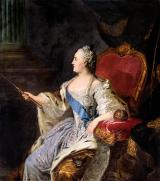
Ecaterina a II-a (în rusă Екатерина II Великая), de asemenea cunoscută și ca Ecaterina cea Mare (în germană Katharina die Große) (n. , Stettin, Regatul Prusiei – d. , Sankt Petersburg, Imperiul Rus), născută Sophie Augusta Fredericka de Anhalt-Zerbst, a fost împărăteasă a Rusiei de la 9 iulie 1762 (stil nou), după asasinarea soțului ei, Petru al III-lea al Rusiei, până la moartea ei, la 17 noiembrie 1796 (stil nou).
Citește mai mult...Alexander Yermolov
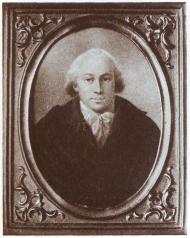
Alexander Petrovich Yermolov (1754–1834) was a Russian favourite and the lover of Catherine the Great from 1785 to 1786.
Yermolov was presented to Catherine by Grigory Potemkin, tested by Anna Protasova and became Catherine's lover in 1785. He collaborated with the enemies of Potemkin and attempted to have Potemkin removed, and thereby lost his position. He went to Paris in the late 1780s and spent the rest of his life in Schloss Frohsdorf.
Citește mai mult...Ecaterina a II-a a Rusiei
Ivan Rimsky-Korsakov

Ivan Nikolajevich Rimsky-Korsakov, né Korsav (29 June 1754 – 31 July 1831 in Saint Petersburg, Russian Empire) was a Russian courtier and lover of Catherine the Great from 1778 to 1779.
Citește mai mult...Ecaterina a II-a a Rusiei
Alexander Dmitriev-Mamonov

Count Alexander Matveyevich Dmitriev-Mamonov (Russian: Александр Матвеевич Дмитриев-Мамонов; 30 September 1758 – 11 October 1803, buried in Donskoy Monastery) was a lover of Catherine II of Russia from 1786 to 1789.
Citește mai mult...Ecaterina a II-a a Rusiei
Alexander Lanskoy
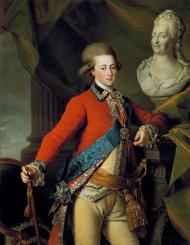
Alexander Dmitrievich Lanskoy, also called Sashin'ka or Sasha, (19 March [O.S. 8 March] 1758 – 6 July [O.S. 25 June] 1784) was a Russian general, favourite and lover of Catherine the Great between 1780 and 1784. It has been said that "[a] look at [her] correspondence with her favorites gives the impression she only had tender feelings for one, Alexander Lanskoi."
Citește mai mult...Ecaterina a II-a a Rusiei
Sergei Saltykov

Le comte Sergei Vasilievich Saltykov (en russe : Сергей Васильевич Салтыков), né en 1722, et mort le 24 septembre 1784, est un officier et diplomate russe qui fut le premier favori de l'impératrice Catherine II quand elle n'était encore que grande-duchesse.
Citește mai mult...Ecaterina a II-a a Rusiei
Pyotr Zavadovsky
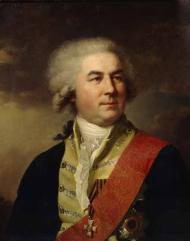
Peter Vasiljevitj Zavadovskij (ryska: Пётр Васильевич Завадовский), född 10 januari 1739, död 10 januari 1812, var en rysk greve och gunstling till Katarina den stora.
Zavadovskij blev 1775 Katarinas sekreterare och blev den 2 januari 1776 hennes generaladjutant och älskare. Han beskrivs som stilig, kultiverad och allvarlig samt anses ha varit uppriktigt förälskad i Katarina. Förhållandet var ansträngt på grund av den svartsjuka han kände mot Potemkin, vars nära relation med Katarina fortgick trots att han i egenskap av älskare hade ersatt honom; även Potemkin ryktas ha haft åtminstone ett vredesutbrott på grund av relationen. Förhållandet avslutades på grund av de ständiga slitningarna och han ersattes 1777 av Simon Zoritj. Då relationen med Zoritj avslutades 1778 ska Katarina ha övervägt att återkalla Zavadovksij, men hon mötte då i stället Ivan Rimskij-Korsakov.
Citește mai mult...Ecaterina a II-a a Rusiei
Semyon Zorich

Count Semyon Zorich (1743–1799) was a Serbian-born Russian lieutenant-general and count of the Holy Roman Empire. He served Russia against the Prussians and Turks. A member of the Russian court, he was presented to Empress Catherine the Great by Grigory Potemkin and, after having been tested by Praskovja Bruce and doctor Rogerson, became the Empress' lover. He was most influential in the commercial development of Shklov and Mogilev.
Citește mai mult...Ecaterina a II-a a Rusiei
Alexander Vasilchikov
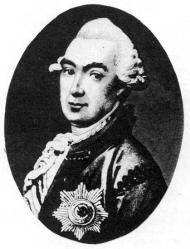
Alexander Semyonovich Vasilchikov (Russian: Александр Семёнович Васильчиков, tr. Aleksandr Semënovič Vasil'čikov; 1746–1813) was a Russian aristocrat who became the lover of Catherine the Great from 1772 to 1774.
Vasilchikov was an ensign in the Chevalier Guard Regiment when he was noted by Catherine and was appointed gentleman of the bedchamber on 1 August 1772. When Catherine's then-lover Grigory Grigoryevich Orlov left court, Catherine was informed about his adultery, and 12 August, Vasilchikov was made general aide-de-camp and lover of Catherine. Vasilchikov was expected to be available to attend on her at all times, and was not allowed to leave the palace without permission.
The relationship was short-lived. Catherine found Vasilchikov's gentleness cloying, saying "His tenderness made me weep." When Vasilchikov was away on a journey, sent by the empress, Grigory Potemkin replaced him as her lover. She wrote to her friend Friedrich Melchior, Baron von Grimm about Vasilchikov's dismissal: "Why do you reproach me because I dismiss a well-meaning but extremely boring bourgeois in favour of one of the greatest, the most comical and amusing, characters of this iron century?"
Vasilchikov later complained that he felt like a hired gigolo: "I was nothing more to her than a kind of male cocotte and I was treated as such. If I made a request for myself or anyone else, she did not reply, but the next day I found a bank-note for several thousand rubles in my pocket. She never condescended to discuss with me any matters that lay close to my heart."
Catherine characteristically rewarded her former lover richly. Vasilchikov was given a pension of twenty thousand rubles and valuable properties. He lived the rest of his life in Moscow. He never married. He built a notable collection of Western European paintings and sculptures, including a "Self Portrait" by Velasquez and works by Philips Wouwerman and Andries Botha.
Citește mai mult...Ecaterina a II-a a Rusiei
Platon Zubov
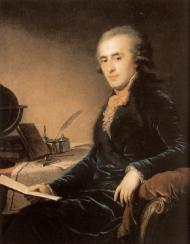
Prince Platon Alexandrovich Zubov (Russian: Платон Александрович Зубов; November 26 [O.S. November 15] 1767 – April 19 [O.S. April 7] 1822) was the last of Catherine the Great's favourites and the most powerful man in the Russian Empire during the last years of her reign.
Citește mai mult...Ecaterina a II-a a Rusiei
Gregory Potyomkin
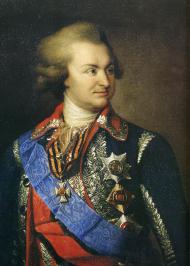
Grigori Aleksandrovici Potemkin (în rusă Григорий Александрович Потёмкин, transliterat: Grigori Aleksandrovici Potiomkin; n. , Чижево(d), Guvernoratul Smolensk, Imperiul Rus – d. , Rădenii Vechi, raionul Ungheni, Republica Moldova) a fost un general-feldmareșal rus, demnitar al statului și favorit al țarinei Ecaterina a II-a a Rusiei. A murit la Rădenii Vechi, Moldova, în timpul unei călătorii de la Iași spre Nikolaev. A fost înhumat în Catedrala din Herson, Imperiul Rus (azi în Ucraina).
Termenul „potemkiniadă” este legat de numele său.
Citește mai mult...Ecaterina a II-a a Rusiei
Grigori Grigorievici Orlov
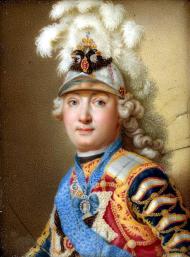
Prince Grigory Grigoryevich Orlov (Russian: Григорий Григорьевич Орлов; 17 October 1734 – 24 April 1783) was a Russian general and patron of arts who was Prince of the Holy Roman Empire (1772) and a favourite of Empress Catherine the Great. He was a leader of the 1762 coup which overthrew Catherine's husband Peter III and installed Catherine as reigning empress. For some years he was virtually co-ruler with her, but his repeated infidelities and the enmity of Catherine's other advisers led to his fall from power.
He patronised M. V. Lomonosov, D. I. Fonvisin, V. I. Bazhenov and gave them financial support. Honorary member of the Imperial Academy of Arts (since 1765). He collected paintings (including Rembrandt, P. P. Rubens, Titian), sculpture, Chinese, Japanese and Russian porcelain, hunting weapons, etc. (Orlov's collection has been preserved almost completely; it is now in the State Museum-Reserve "Gatchina" of the eponymous city). A large landowner, Orlov commissioned the construction of the Great Gatchina Palace.
Citește mai mult...Ecaterina a II-a a Rusiei
Stanisław August Poniatowski
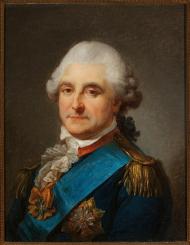
Stanisław II August sau Stanisław Antoni Poniatowski (n. , Wołczyn(d), Marele Ducat al Lituaniei, Polonia-Lituania – d. , Sankt Petersburg, Imperiul Rus), numit și Stanisław al II-lea, a fost ultimul Rege al Poloniei și Mare Duce al Lituaniei (1764-1795). A fost fiul contelui Stanisław Poniatowski (1676-1762), castelanul Cracoviei, și al principesei Konstancja Czartoryska. A fost fratele lui Michal Jerzy Poniatowski și unchiul prințului Józef Poniatowski. Tatăl lui era amantul Ecaterinei a II-a a Rusiei, ceea ce i-a facilitat urcarea pe tronul polonez. A fost ales rege la data de 7 septembrie 1764 și încoronat la 25 noiembrie în același an. Cu prilejul primei divizări din 1772, porțiuni din teritoriul polonez au fost atribuite Rusiei, Austriei și Prusiei. Perioada cuprinsă între 1773 și 1792 a fost una de renaștere națională, sprijinită de Stanisław, dar în 1793 acesta a fost forțat să accepte o a doua divizare, în urma căreia a devenit vasal de facto al Rusiei, cu un regat ciopârțit. Anihilarea Poloniei a fost definitivată în 1795, după zdrobirea unei răscoale naționaliste. În noiembrie 1795 Stanisław a fost forțat să abdice.
Citește mai mult...