Cine s-a întâlnit cu Julia Mamea?
Caracalla datează Julia Mamea de la ? până la ?.
Julia Mamea
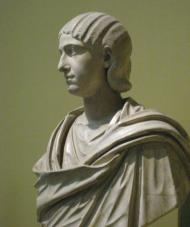
Julia Avita Mamea (en latín: Iulia Avita Mamæa), nacida el 29 de agosto de 180 en Emesa (actual Homs, Siria), muerta en 235, fue la segunda hija de Julia Mesa, una poderosa matrona romana de origen sirio y del noble Julio Avito. El cognomen de Mamea proviene del árabe, al igual que el de Domna, Maesa o Soemias. Deriva de Māma, un arcaísmo atestiguado en el matronímico de una figura preislámica, Ka'b ibn Mama. Fue sobrina de la emperatriz Julia Domna y del emperador Septimio Severo y hermana de Julia Soemia Basiana, y madre del emperador Alejandro Severo, sobre el que ejerció gran influencia. Durante una campaña contra los germanos, los soldados se amotinaron y mataron al joven emperador y a su progenitora.
Citește mai mult...Caracalla

Marcus Aurelius Antoninus (born Lucius Septimius Bassianus, 4 April 188 – 8 April 217), better known by his nickname Caracalla (; Latin: [karaˈkalːa]), was Roman emperor from 198 to 217 AD, first serving as nominal co-emperor under his father and then ruling alone after 211 AD. He was a member of the Severan dynasty, the elder son of Emperor Septimius Severus and Empress Julia Domna. Severus proclaimed Caracalla co-ruler in 198, doing the same with his other son Geta in 209. The two brothers briefly shared power after their father's death in 211, but Caracalla soon had Geta murdered by the Praetorian Guard and became sole ruler of the Roman Empire. Julia Domna had a significant share in governance, since Caracalla found administration to be mundane. His reign featured domestic instability and external invasions by the Germanic peoples.
Caracalla issued the Antonine Constitution (Latin: Constitutio Antoniniana), also known as the Edict of Caracalla, which granted Roman citizenship to all free inhabitants (except the dediticii) throughout the Roman Empire. The edict gave all the enfranchised men Caracalla's adopted praenomen and nomen: "Marcus Aurelius". Other landmarks of his reign were the construction of the Baths of Caracalla, the second-largest bathing complex in the history of Rome, the introduction of a new Roman currency named the antoninianus, a sort of double denarius, and the massacres he ordered, both in Rome and elsewhere in the empire. In 216, Caracalla began a campaign against the Parthian Empire. He did not see this campaign through to completion due to his assassination by a disaffected soldier in 217. Macrinus succeeded him as emperor three days later.
The ancient sources portray Caracalla as a cruel tyrant; his contemporaries Cassius Dio (c. 155 – c. 235) and Herodian (c. 170 – c. 240) present him as a soldier first and an emperor second. In the 12th century, Geoffrey of Monmouth started the legend of Caracalla's role as king of Britain. Later, in the 18th century, the works of French painters revived images of Caracalla due to apparent parallels between Caracalla's tyranny and that ascribed to French King Louis XVI (r. 1774–1792). Modern works continue to portray Caracalla as an evil ruler, painting him as one of the most tyrannical of all Roman emperors.
Citește mai mult...